The Greece-China Connection
The Color Blue for Repelling Evil |
 |
|
by Theresa
Mitsopoulou Blue
church cupolas, windows, doors, walls, staircases and
fences, but also blue “belts” (samaria) around the
buildings, will provide protection from Evil.
Blue-turquoise stones on jewelry, belts and weapons,
will safeguard people and animals and even plants
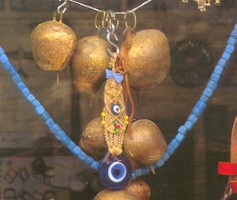
(chaimalia) against Evil. Blue “eyes” and blue stones
mounted on gold and silver are presented to babies and
small children as a talisman for protection, like the
sky-blue scarf around the neck of boy-scouts.
|
|
|
|
|
|
Its
ancient name “cyanus” refers, apart from the mineral
stone, to the artificial glass and to the paint as
well. The natural turquoise stone decorated
mainly jewels and weapons, statues, like the statue of
Zeus in Olympia had eyes of turquoise inserted and in
this practice the Greeks imagined their Gods and
heroes as blue-eyed. 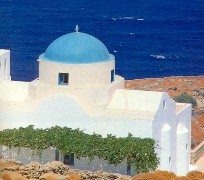 The
turquoise paint that the painters used was the product
of powder turquoise stone mixed with other ingredients
or a mixture of copper from Cyprus and sand. The third
and most expensive paint was made with the plant
“Indian cyanus” (indigo, bluing). Architectural parts
of public buildings, like the triglyphs and mutule of
the Parthenon, as well as parts of villas in Pompeii
and Rome, were painted in turquoise. In Athens, at
Omonia square, on Dorou street No. 1 and on Stadiou
street No. 58, blue friezes surround restored
neoclassical buildings. Similar friezes are found in
the Ionian islands, in the Cyclades, in the islands of
the Argosaronic gulf and in Macedonia, in the villages
of Mt. Paghaion. The
turquoise paint that the painters used was the product
of powder turquoise stone mixed with other ingredients
or a mixture of copper from Cyprus and sand. The third
and most expensive paint was made with the plant
“Indian cyanus” (indigo, bluing). Architectural parts
of public buildings, like the triglyphs and mutule of
the Parthenon, as well as parts of villas in Pompeii
and Rome, were painted in turquoise. In Athens, at
Omonia square, on Dorou street No. 1 and on Stadiou
street No. 58, blue friezes surround restored
neoclassical buildings. Similar friezes are found in
the Ionian islands, in the Cyclades, in the islands of
the Argosaronic gulf and in Macedonia, in the villages
of Mt. Paghaion. The
custom is of worldwide dimension, because even today
in provinces of Spain (like in the Mancha of Don
Quixote) buildings are decorated with blue bands and
designs. Also, houses in Egypt, in the Arab villages
of Israel, and entire villages in Moroco, have blue
walls. The same turquoise color decorates the houses
of Mexican Indians and strongly speaks of common
universal civilization features.
|
|
|
|
|
 In the
Cyclades, next to white color, the prevailing color is
blue-turquoise color. The preference comes from an old
belief of man, that the sky-blue shade had the power
to keep Evil away. The radiation of the color
composed an invisible shield, which prevented the
approach of bad spirits.
In the
Cyclades, next to white color, the prevailing color is
blue-turquoise color. The preference comes from an old
belief of man, that the sky-blue shade had the power
to keep Evil away. The radiation of the color
composed an invisible shield, which prevented the
approach of bad spirits. 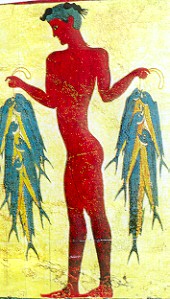 On the
murals of Santorini island (about 1700 BC) bracelets
for the wrist, the arm and ankle, and necklaces, are
made of precious or semiprecious stones, while the
shaved part of the head of young people (male and
female) is painted blue-turquoise. It is
amazing, that on traditional Chinese New Year’s cards,
one can see the same fashion copied since thousands of
years ago. Small children also have their hair
partly shaved in similar arrangement (two or three
locks of hair) with the shaved part also painted
blue-turquoise. The artist used the turquoise
color believing that it would provide protection for
his heroes. Also, on special occasions like birthdays,
initiation of adolescence, the shaved parts of their
heads were smeared with blue paint, their face with
white and their lips and cheeks with red (like actors
used to do).
On the
murals of Santorini island (about 1700 BC) bracelets
for the wrist, the arm and ankle, and necklaces, are
made of precious or semiprecious stones, while the
shaved part of the head of young people (male and
female) is painted blue-turquoise. It is
amazing, that on traditional Chinese New Year’s cards,
one can see the same fashion copied since thousands of
years ago. Small children also have their hair
partly shaved in similar arrangement (two or three
locks of hair) with the shaved part also painted
blue-turquoise. The artist used the turquoise
color believing that it would provide protection for
his heroes. Also, on special occasions like birthdays,
initiation of adolescence, the shaved parts of their
heads were smeared with blue paint, their face with
white and their lips and cheeks with red (like actors
used to do). 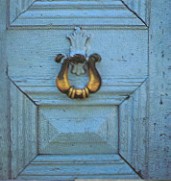 The
ancient Egyptians were furnished with the
turquoise-blue stone (cyanus, lapis lazuli) from the
Sinai peninsula since the 4th millenium BC. The
precious material is found in abundance in Tourkestan
where its name originates. It was also known in
Cyprus but according to ancient writers, the best
quality was the Scythian turquoise, whose origin was
most probably Chinese. Today, it is mined in
North America (California, Arizona) in Central America
(Mexico), in Australia, in North Africa and in
Siberia. In North America the artifacts of the Indians
decorated with the precious blue stone are well
known. In Europe the stone is imported mainly
from Iran (province of Isfahan), where the best
variation of the stone is found. Its shape is
opaque and very hard, but porous, and changes color
(it turns to green) and “dies”, when it comes in
contact with perfumes and cosmetics.
The
ancient Egyptians were furnished with the
turquoise-blue stone (cyanus, lapis lazuli) from the
Sinai peninsula since the 4th millenium BC. The
precious material is found in abundance in Tourkestan
where its name originates. It was also known in
Cyprus but according to ancient writers, the best
quality was the Scythian turquoise, whose origin was
most probably Chinese. Today, it is mined in
North America (California, Arizona) in Central America
(Mexico), in Australia, in North Africa and in
Siberia. In North America the artifacts of the Indians
decorated with the precious blue stone are well
known. In Europe the stone is imported mainly
from Iran (province of Isfahan), where the best
variation of the stone is found. Its shape is
opaque and very hard, but porous, and changes color
(it turns to green) and “dies”, when it comes in
contact with perfumes and cosmetics.
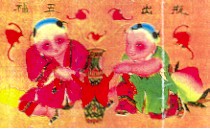 Notice
the similarities between this
traditional Chinese New-Years card and
the Fisherman from Santorini above. Both have locks of hair and
their shaved heads painted blue
Notice
the similarities between this
traditional Chinese New-Years card and
the Fisherman from Santorini above. Both have locks of hair and
their shaved heads painted blue|
|
Questions? E-mail Matt
|
|
|
|
|
Help Support Matt's Greece Travel Guides |
|
|
|
|