Beaches and More...
|
|
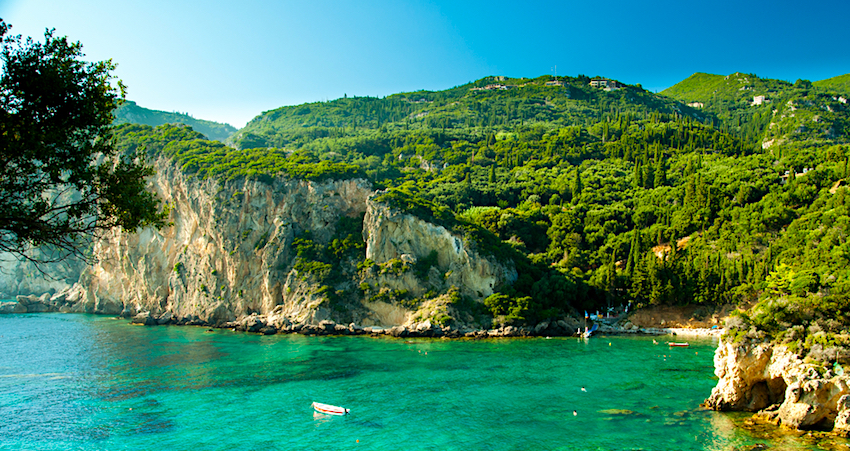
Corfu is famous for having some of the most beautiful beaches in the Mediterranean. Some are endless stretches of sand (on the west and north coasts), others are sheltered pebble coves (mostly on the mainland-facing shoreline), plus there are a fair few somewhere in between. The east coast of Corfu above Kérkyra Town, and the far north coast, are completely tourist-developed and unless you care nothing about Greek culture and only about baking like a reptile
on the beach all day and hitting the local bars at night you may want to steer clear of those areas in the summer months. But what the hell? If this is your idea of fun there is nothing wrong with that. We can't all be Grecophiles, a holiday is a holiday and there is something to be said for being able to get drunk with someone from home while in a far-away place. As tacky as the beach resorts may be in the summer, if you come here in low season (but not winter, obviously) they can be quite peaceful; even in
the summer, to escape the crowds just get in a car and drive inland for some of the most beautiful scenery in Greece.
|
 |
|
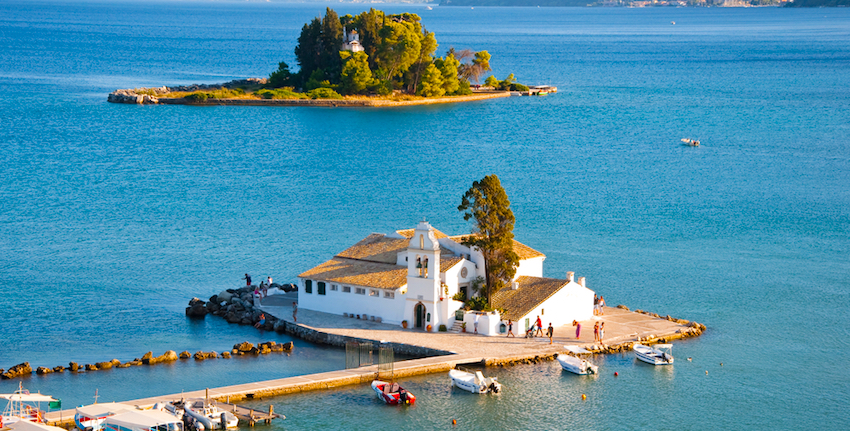
The first attraction south of town, too far to walk to but easily reached by #2 blue bus, is Kanóni, so named for an artillery piece poised here by the French. Here at the end of the peninsula also home to ancient Paleópolis and the Mon Repos villa-museum (both worth a stop) is the overlook of Panagía Vlahernón monastery and Pondikonísi (Mouse Islet) just beyond. Medieval Vlahernón, which pretty much covers its own islet, is tethered to the rest
of Corfu by a small causeway lined with fishing boats; Pondikonísi, with dense stands of trees all but hiding a small, undistinguished Byzantine chapel and a drinks bar, can only be visited by excursion boat from the causeway harbour. Pondikonísi is a prime candidate for being the Phaeacian ship petrified by the vengeful Poseidon on its return from Ithaka. The Kanóni belvedere, with handy cafés, is a favourite vantage point for taking one of the millions of photos of the scene which will have been snapped over
the years – despite the rather unphotogenic (but ecologically important) Halikopoúlou lagoon just to the right, and the constant descent of jets to the adjacent airport runway. Another, larger causeway (pedestrians only) crosses the mouth of the lagoon to Pérama on Corfu’s east coast.
|
 |
|
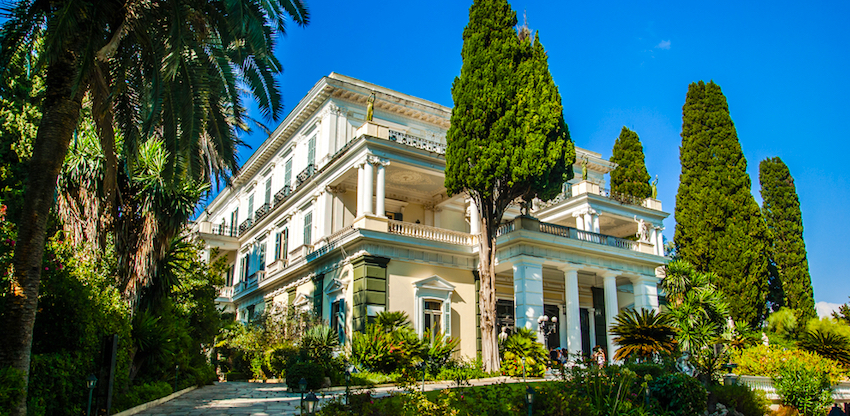
Just southwest of Pérama, but uphill and inland, is the main island bus-tour destination, the Achilleion Palace. This was designed and built by Austrian empress Elisabeth (better known as ‘Sisi’), who bought the land here in 1889 and within 3 years designed and built the palace in a style best termed Classical Kitsch. It has always been fashionable to deride the building (as did Lawrence Durrell and Henry Miller), and/or make fun of the unhappy empress
who retired here semi-permanently after the breakdown of her marriage and suicide of her only son. But the empress was no bimba, and with the help of local tutors managed to learn competent modern Greek, something utterly beyond most contemporary expats. After Sisi was stabbed to death by an anarchist in Geneva in 1898, Kaiser Wilhelm II bought the place from her daughter, only to lose it in turn to the Greek state as war reparations in 1919. In the meantime it had been commandeered by the Allies as a military
hospital, and just downhill from the palace is a large, well-tended cemetery of French casualties – one of those secret corners in which Corfu abounds. Since then, the Achilleion housed the island casino for some decades and served as a location for the James Bond film For Your Eyes Only before becoming a museum in the 1990s. All this by way of saying that palace’s history is rather more interesting than the exhibits and ostentatious murals inside. The formal gardens, with their two contrasting statues of Sisi’s
hero Achilles (the larger put up by Kaiser Wilhelm II), afford great views towards Kérkyra Town and are a favourite photo op for amorous couples.
|
 |
|
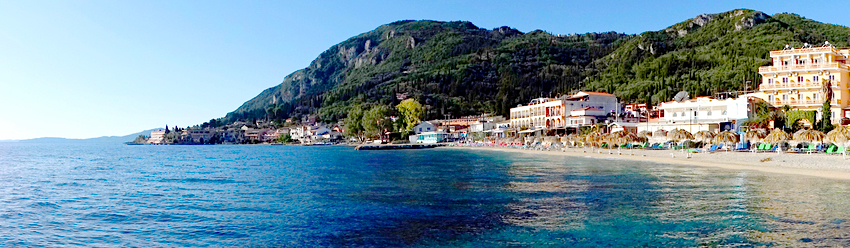
Just downhill from the Achilleion is the first notable east-coast resort, Benítses (photo),
now rather quiet after its long-standing British-lout clientele
deserted it for greener pastures (eg Kávos) during the 1990s. Something
of its original identity as a fishing village now shows through,
especially with the recent completion (supposedly with Russian money) of
the newest yacht marina on the island, which also doubles as a handy
base for excursion boats to Párga on the mainland and Paxí island. There
is little to see other than the underwhelming ruins of a Roman baths,
and local beaches are serviceable at best, but Benítses is getting a new
lease on life as an overnight halt on the Corfu Trail traverse. The old
village centre opposite the marina retains some character, and a couple
of restaurants that Greeks and philhellenes will eat at – particularly
the inconspicuous Klimataria tou Bellou, where a father-and-son
team do creatively executed fresh seafood at friendly prices (tel
26610 71201, www.klimataria-restaurant.gr. Open Mon–Sat dinner only,
Sunday lunch; winter weekends only, closed 1 Dec–15 Jan).
|
|
|
|
South of Benítses, Moraïtika and Mesongí are both busy, MOR resorts
slowly being taken over by all-inclusive hotel programs and a
non-English-speaking market. Again, beaches are pebbly and narrow, if
usually calm, so for something different head west at the big Mesongí
roundabout towards the far coast of the island, beyond the artificial lagoon of Korissíon
(fashioned by the Venetians as a fish nursery and still used as such).
The little canal linking it to the open sea divides the sandspit closing
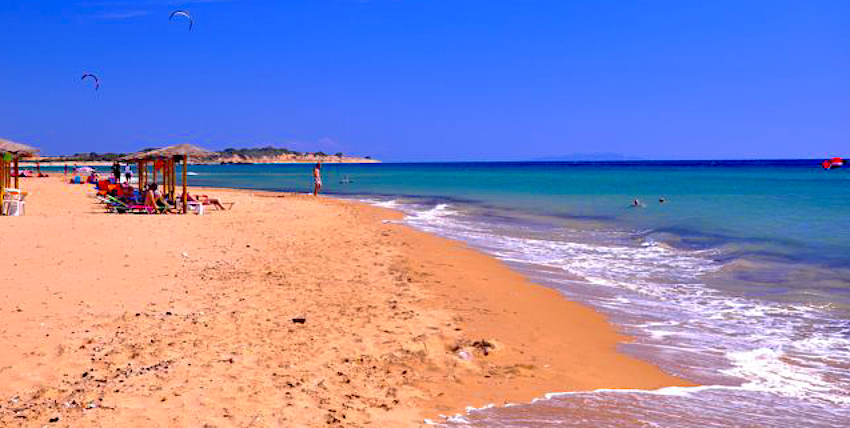
off the lagoon into two beach sections. Halikoúnas(photo), the northwesterly bit, has excellent sand, a kite-surfing centre and – just west off the access road, the idyllic Alonaki Bay taverna (tel 26610 75872). They do a rendition of the local specialty biánko based on grey mullet (kéfalos),
a fish generally despised everywhere in the Mediterranean as a
bottom-feeding scavenger, but here succulent because raised in
controlled conditions in the lagoon. It comes garnished with marsh
samphire (Salicornia europaea) – I didn’t catch the local name,
but it looks (and tastes) a bit like asparagus. To get to the other
lagoon beach, Íssos, you have to go clockwise all the way around the
lagoon to Línia village. Íssos is even more spectacular (and
popular) than Halikoúnas, with sculpted rock formations (another James
Bond filmic location), heaped-up dunes (sheltering the odd nudist) and a
windsurf school.
|
|
Beyond Línia, the island trunk road threads through agricultural
villages, with side-turnings to more southwest-facing beaches, the best
of these probably Paralía Marathiá and its cliff-backed neighbour Agía Varvára.
The entire coast here is in fact one continuous beach, and if you
wanted to you could walk all the way from Íssos down to the
southeasterly tip of Corfu, Cape Asprókavos. Thus the name of the nearby
resort that’s the island incarnation of Sodom and Gomorrah in local
(and overseas?) minds, Kávos, which acquired considerable
notoriety in 2003 when several Club 18–30 reps engaged in a public,
daytime blow-job contest. They were videoed by an outraged Greek
holidaymaker, and had to leave Corfu under threat of prosecution for
gross indecency. Since then Kávos has come down in the world (pardon the
pun), with many of its music clubs and bars idle or shut even in peak
season, and struggles to re-invent itself as a family-friendly resort.
An uphill struggle I’d say, given the scrappy beach intermittently
covered with raw sewage and used condoms, according to web forums. The main road back bypasses Lefkímmi,
the island’s second largest town, largely indifferent to tourism but
with the novelty of being divided by a year-round river. I used to like
to eat at one of the handful of riverbank restaurants, Maria, as
much for the eponymous proprietress as for the food. Maria was herself a
river of scurrilous tales and baroquely elaborate obscenities who could
have taught the Kávos BJ contestants a thing or two. Sadly, she and the
restaurant have vanished without trace, so raise a glass to her memory
and continue on to Boúkari on the coast north of Argyrádes. Here the Boukari Beach
taverna (tel: 26620 51791), run by the welcoming Vlahopoulos family, is
ace for affordable seafood like steamed mussels or tender octopus, and
they also have very attractively priced accommodation
(www.boukaribeach.gr) in family-suitable villas or a conventional hotel
if you decide to drop anchor here.
|
 |
|
THE WEST COAST
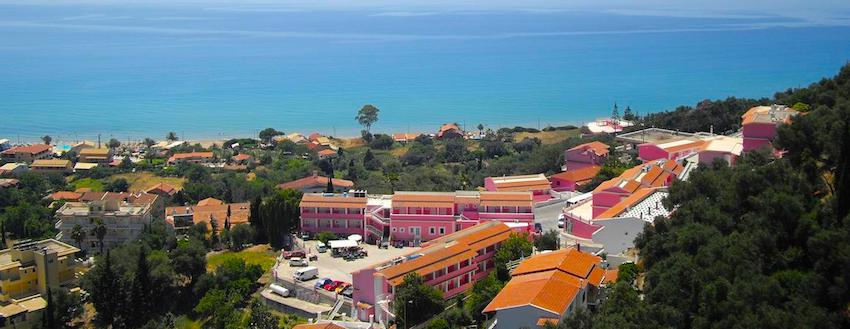
More or less due west of Benítses, but reach by a more direct road via the airport and Kynopiástes, Ágios Górdios (universally known as Áï Górdis)
is one of Corfu’s more popular resorts despite a rather average beach
by Corfiot standards (though with a very scenic sea-stack at one end,
the Orthólithos; Corfiot writer Iakovos Polyllas wrote a short story in
which the main character leaps to her death from the summit). Áï Górdis
is fairly well dominated by the famous Pink Palace, known to students and party animals across the world. This sprawling
hotel/hostel complex stages lots of activities to keep young people
happy and occupied, from water-skiing and volleyball to drinking
contests. For many young people touring Europe for the first time, this
is the last stop and for some people who make the mistake of beginning
their European holiday here it is also their last stop. Like Íos island,
it’s the sort of place you must force yourself to leave so you can get
on with the rest of your life – and the rest of Corfu.
On the way down to Áï Górdis, you’ll have skirted Sinarádes, an attractive and still thriving village with the quirky History and Folklore Museum of Central Corfu, an old house minimally changed from its past as a dwelling other than a top-floor gallery of rare exhibits, such as a papyrélla
raft made of cane fennel, of a design used from ancient times until the
1950s, and birthing saddles used by village women when in labour.
|
 |
|
Heading north from Sinarádes, the next place is Pélekas, one of
the few inland villages with significant tourism (evident in multiple
tavernas), thanks to its superb views (a natural rock formation just
uphill is called the Kaiser’s Throne after Wilhelm II’s habit of coming
here to watch the sunsets) and proximity to several beaches. The closest
is Kondógialos, about 700m long but a bit narrow, with wooden
walkways at points to cross the burning sand. In low season you might
find some free parking near the little anchorage, but note that all
popular west-coast beaches generally have stiff parking fees – and at
times considerable surf and undertow which could be dangerous in the
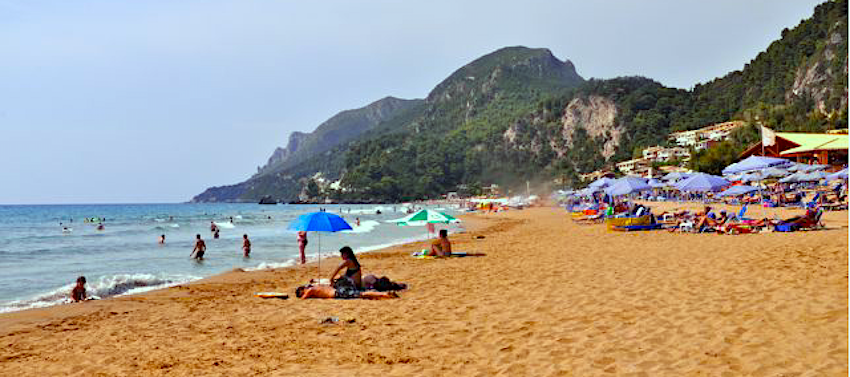
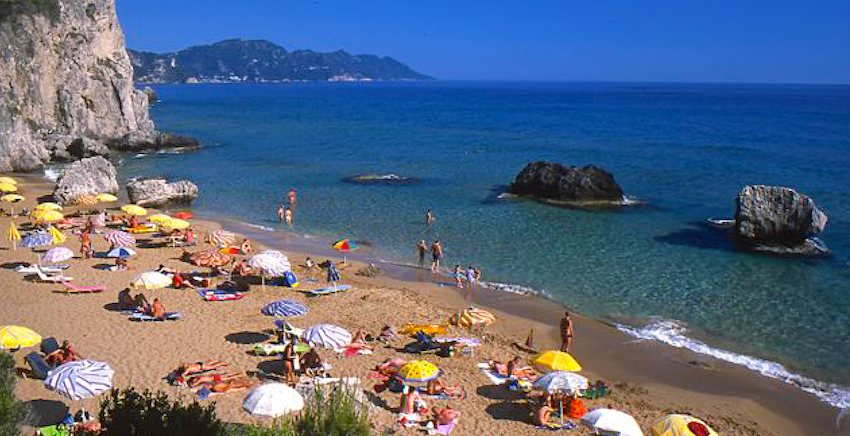
absence of lifeguards. Glyfáda(photo), the next beach up, is a tad
shorter but fatter, and a bit encroached upon by two hotel complexes,
but has showers, sunbeds and water sports facilities.
|
|
|
|
There’s little of that at Myrtiótissa
further along (with yet another steep, winding access track), touted
rather implausibly by Lawrence Durrell as the world’s most beautiful
beach – he must have had his beer goggles on that day, a not uncommon
occurrence for the old sot. The reality is a decidedly small,
diamond-shaped patch of sand at the base of cliffs, crammed to the gills
with nudists in peak season, and a corral of boulders just offshore
providing some shelter from the waves. For my recent update of the Berlitz Pocket Guide to Corfu,
I was handed an irate email from a Brussels-based Englishman taking
issue with Myrtiótissa’s lazy rating in the book as World’s Best. He was
also particularly exercised by the quantity of “elderly scrota” on
display – presumably not enough young boobs on offer to please him? So I
went back to have another look after being away for some years. Scrota
of a certain age there certainly were, and a definite
gay/countercultural ethos. And bad vibes upon my arrival, when one of
the hippie-trinket sellers was engaged in thumping the hell out of
somebody (male) who had been behaving in an unspecified inappropriate
manner. One for off-season then, when you might even get a parking place
within 300m of the sea, and might gain admission to the wonderfully
perched medieval monastery of Myrtiótissa just uphill, averting its eyes from all the naked flesh on the sand below.
|
 |
|
From the vicinity of Myrtiótissa you can get to Paleokastrítsa via some
narrow secondary roads skirting the large Rópa Valley on its west, but
most people arrive direct from Kérkyra Town on a relatively fast, wide
highway whose predecessor was opened by High Commissioner Frederick Adam
during the 1820s to facilitate picnics out here with his Greek wife.
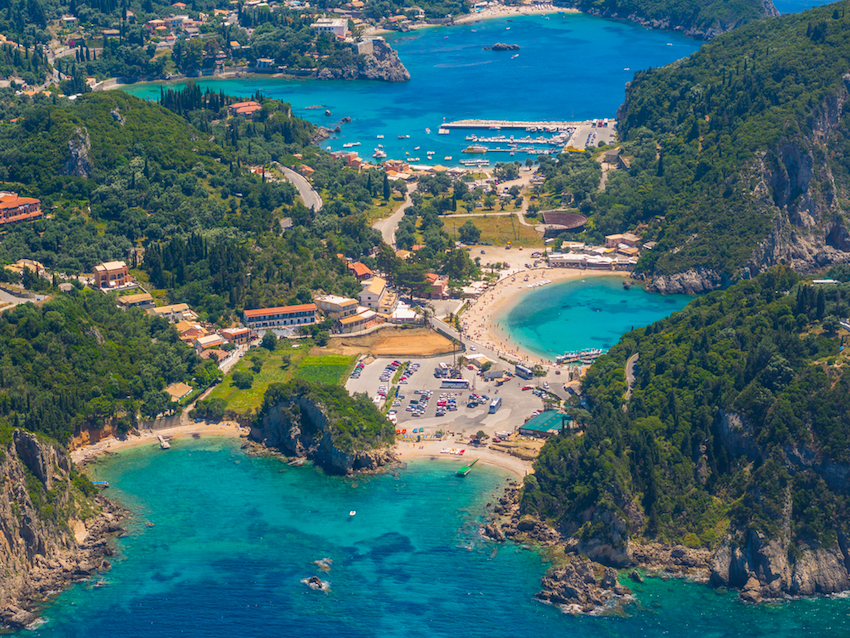
However you get there, Paleokastrítsa is a stunner, at least seen
from a distance, an improbably convoluted seascape of lushly vegetated
cliffs and promontories, tiny pebble or sand coves, sea-caves
(boat-trips visit them) plus little islets offshore (a couple of these
being more candidates for the petrified Phaeacian ship victimized by
Poseidon). Up close it may not seem so enchanting, with traffic jams,
standing room only on the beaches, touristy tavernas, and astoundingly
high prices at the two local scuba-dive outfitters (probably because of
the exorbitant premises rental they must pay). On the furthest
promontory, but still accessible by tourist buses, is the
pastel-coloured, monk-inhabited Theotókou Monastery, with
burgeoning gardens, arcaded passages, an odd little museum and more fine
views; although founded in 1228, the monastery’s present buildings date
from after a fire during the 1600s.
|
|
|
|
From Paleokastrítsa, you can head via the “balcony village” of Lákones (plenty of food and lodging) and Makrádes to Angelókastro,
a Byzantine castle probably built during the 12th century by Emperor
Manuel I Komnenos and revamped by the Despot of Epiros Mihaïl Angelos
Komnenos in the next century. It was closed in recent years for further
refurbishment and has now re-opened (Mon–Fri only), though there is
little to see inside other than massive cisterns, an underground shrine
(locked) and, at the summit with its sweeping panorama, some rock-cut
graves. The compact castle served as an advance watchpoint for mischief
on the Ionian Sea; bad news could be relayed by signal fire to the
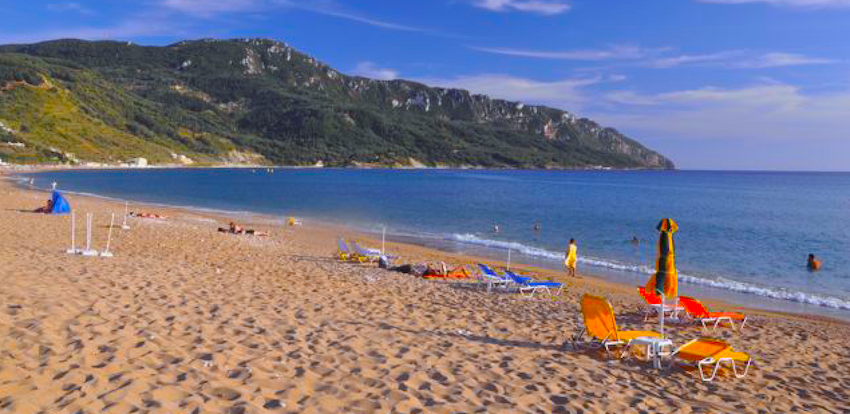
citadels in Kérkyra Town. At Makrádes “tourist bazaar”, the onward road heads through the olive groves for Pági village and then down to Ágios Geórgios Págon(photo),
a vast bay bracketed by two headlands, with one of the best, least
regimented and (at the far end at least) cleanest, calmest beaches on
the island. At mid-beach there’s considerable windsurfing activity, plus
a family-pitched resort of sorts. I’ve eaten well a couple of times
1500m south along a bumpy track at seafood specialists Akrogiali (tel: 6977 334278); look for the decorative windmill.
|
|
Most people will be satisfied with Ágios Geórgios, but if not, two more resorts beckon further up the coast: Arílas (also home to the island’s microbrewery) and Ágios Stéfanos Avliotón, both fairly low-key and family-pitched – no Kávos style excess here. Just offshore from the latter hover Mathráki and Othoní,
the two westernmost of Corfu’s satellite Diapóndia islets, a favourite
hideout of Italians in summer but pretty empty otherwise. Little daily
ferries go there from Ágios Stéfanos’ equally diminutive port, but if
you intend to stay the night, do your research and booking in advance as
none of the Diapondian islets has more than a few score beds each. All
have lush greenery and varying numbers of beaches; Eríkoussa, the
smallest, easterly islet with the sandiest coastline, is more easily
reached from Sidári on the north coast . Like many islanders from the
northwest part of Corfu, most of the Diapondians have spent some time in
New York, so east-coast English is widely spoken.
|
 |
|
THE FAR NORTH
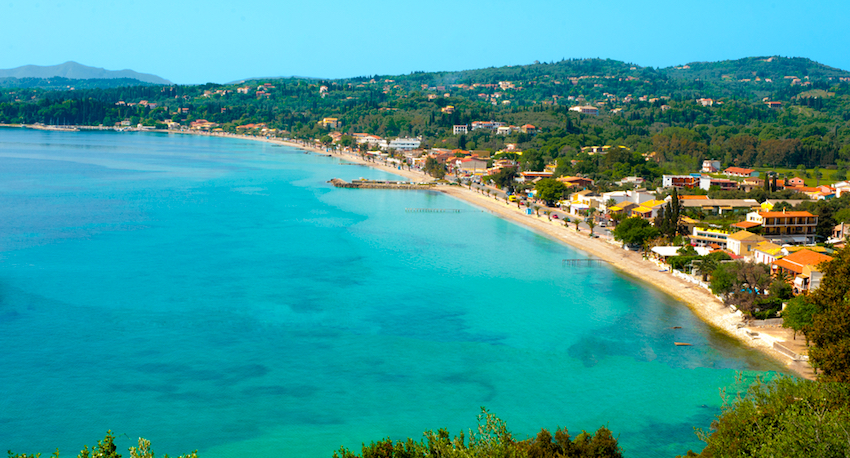
The way north from Kérkyra Town begins rather
unpromisingly with the roadside strip development of Kondókali, Gouviá,
Dassiá and ultimately Ýpsos(photo), the latter resort visibly dying on the vine
after some years spent as a mini-Kávos. This was the first stretch of
Corfu developed for tourism, and given the rather scrappy local beaches
and suburban profile you have to wonder why, other than short transfer
times from the airport in an era when remoter island roads were
unimaginably horrendous (not that they’re great now – mind your
driving). That said, there are some very good luxury hotels along here,
like the Kondokali Bay and Corfu Imperial, self-contained oases that allow you to ignore what’s just outside.
But past Ýpsos the scenery gets abruptly more dramatic as the coast
highway becomes a narrow corniche road threading the lower slopes of Mt
Pandokrátor. Far below on the right through the olive groves are tiny
bays, each with their complement of restaurants and accommodation, and
eyefuls of Albania just opposite. I had a friend who took a vacation
here around 1990, and vividly remembers cowering in terror in her bed by
night whilst Greek coast guard or police personnel took potshots at
escaping Albanians swimming the channel – it’s that close. Today two-way
traffic with Albania is by regular (if expensive) ferry-boat and the
channel is swum only as a promotional stunt.
From Agní all the way around to just before Kassiopí, this shore
rejoices in the flippant nickname “Kensington-on-Sea”, both for the
provenance of most of the clientele, and the prices charged. The Agnelli
dynasty (they of Fiat), Nat Rothschild, Peter Mandelson and assorted
Russian oligarchs all have been, guests, or even own vast estates,
hereabouts. So the tone is set; the scruffy need not apply.
|
|
Note: Instead of
following the “Kensington-on-Sea” corniche, you can leave the coast just
after Ýpsos, at the turning inland for Spartýlas, for the four-wheel
crossing of Mount Pandokrátor. Between Strinýlas and
Petália (each with basic seasonal tavernas) signs indicate the final
approach to the peak. This side road – which traverses limestone
dell-uplands with midget bushes and the odd flock of sheep – is
something not to be attempted in bad weather, and parking space at the
summit is limited. The 360° views encompass the entire sickle outline of
Corfu and, over the narrow channel, a good chunk of Albania. Further to
the south, you’ll glimpse Paxí island and more distant Lefkáda. Sadly,
closer up the panorama now includes the aftermath of an August 2011
forest fire which devastated much of the mountain. Near the top perches the little stone-clad monastery of Ypsiloú Pandokrátora
(open summer only), of 17th-century vintage in its existing form. Just
one monk stays here during the warmer months. With its forest of
telecoms and media antennae, the summit is far from a pristine alpine
experience, and none is worse than the 300-foot-tall transmitter plonked
right in the monastery courtyard. It was erected by the 1967–74
colonels’ junta to beam propaganda into Albania, and the monastery abbot
of the time recently reported being forced at gunpoint to sign papers
“voluntarily” ceding the church property for the antenna. Despite recent
local petitions and initiatives to have it (re)moved, the monstrosity
is still there. From Petália, an easy-to-follow road descends to the north coast.
|
|
Agní cove has three noted tavernas, of which I like best Nikolas ( tel : 26630 91243) which actually features some local dishes and is the most reasonably priced. Kalámi,
the next bay along, has the best pebble beach and is redolent of
Lawrence Durrell, who lived and wrote here from 1935 to 1939 in the
famous White House, now a taverna (downstairs, gets mixed reviews) and
self-catering lodging upstairs – his work table is still part of the
furnishings. You’ll have gathered from my comments at Myrtiótissa that
I’m not a big fan of the man (who may or may not have shacked up with
his own daughter, who later committed suicide) or his works. I dutifully
read his Alexandria Quartet and assorted other titles during my
bohemian university days, but I don’t know if they would withstand
re-reading, or whether he will be read much by anybody in 30 years. The
semi-deification of Durrell in certain circles is utterly mystifying;
more plausibly, on Corfu itself his cult is just a money-spinner for
“Kensington”. Kouloúra , just around the corner from Kalámi, has a single, popular taverna and fine views, though a poor beach; Ágios Stéfanos Sinión
is again more a place to moor a speedboat (a popular means of arrival
hereabouts) than to swim, but it has the widest range of tavernas at any
local bay. My pick here is Fagopotion (tel: 26630 82020), run by
Kostas, a man with an interesting past (he retired here after running a
bouzouki club in Athens for years). It’s fair priced for “Kensington”
and features fresh, wild fish caught out beyond the Diapóndia islets and
interesting takes on island recipes like chard-based tsigarélli.
They’re also, almost uniquely in northern Corfu, open winter weekends.
Rounding the northeast tip of Corfu (either by road, boat or marked
hiking route) gets you to the big, if often windy, pebble bay of Avláki. At Kassiópi,
it’s back to non-exclusive tourism, with a little Angevin castle
overlooking the deeply indented port and pebble beaches scattered
nearby. The closest decent sand beaches are Kalamáki, Ágios Spyrídon and Almyrós to the west.
|
 |
|
If you’re curious about what Mt Pandokrátor is like, the most interesting foray inland is via Loútses to Paleá Períthia,
a time-capsule village in a northerly hollow of the mountain, abandoned
in favour of the coast from the 1960s onward and thus preserving,
cement-free, some exquisite Venetian-era architecture. It’s just a
15-minute drive up from the coast, but a world away; the old stone
houses are slowly being bought up for restoration as vacation homes, but
the main appeal for casual visitors (besides being astride the highest
section of the Corfu Trail) resides in its four tavernas. I favour
Thomas’s O Foros (tel: 6955 950459) just off the old square, for good mezédes and grills at fair prices – plus excellent karydópita for dessert. He also tries to stay open winter weekends. Once past the turning for Almyrós, the Corfiot north coast presents a series of mid-range-to-plain-downmarket beach resorts: Aharávi, Róda, Astrakerí and Sidári.
Sandy beaches here are apt to be functional, and not always the
cleanest, but shelve gently, making them attractive to young families.
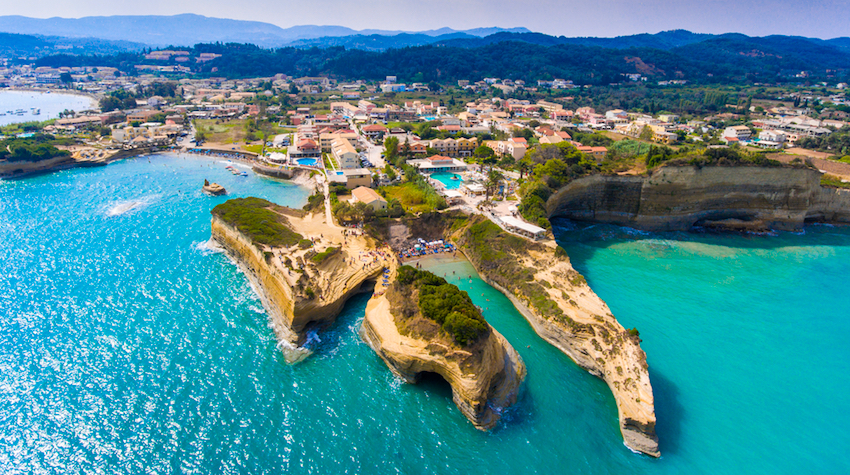
Sidári(photo) is probably the most distinctive spot, given the bizarre
formations eroded out of the coastal rocks just to the west. The same
rock is shaped in a different way at Longás beach, just below
Perouládes village, with a bar perched at the top of the striated
palisade here that’s known as the best sunset-watching venue on Corfu,
even better than the Kaiser’s Throne. In
sum, if you are the contemplative sort, or are after a secluded beach
to have a picnic on, then Corfu with its jet-skis for rent and musical
beach-bars probably isn’t for you, in the same way that the French
Riviera or Copacabana in Rio probably wouldn’t fit the bill. But if you
like that kind of stuff, and are overtly social, than Corfu is cool, and
its best beaches can match anything in Florida or California, never
mind the UK.
Marc Dubin first visited Greece in 1978, fell in love with it, and returned almost yearly until he began living much of the time on Samos in 1989. He has written for numerous travel publishers – notably Rough Guides and Insight Guides – and on a variety of topics ranging from renovating old Greek houses and Greek cuisine to back-country trekking and Greek music. Marc has also compiled two CDs for World Music Network, Rough Guide to Rebetika
and Rough Guide to Greek Café. He is an accomplished photographer and most of the pictures accompanying the articles on greecetravel.com are his. (You can click on his photos above to see them full size.) To contact Marc with offers of writing jobs or praise you can e-mail him through matt@greecetravel.com
|
|
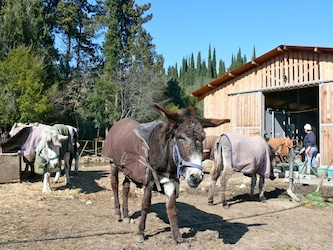 Just outside the village of Doukades which is located on the main
road to Paleokastritsa, there is a wonderful donkey shelter where
visitors are most welcome to visit the donkeys and share the company of
these animals. It is a beautiful place in the middle of olive trees and an oasis.
CDR was started by an English woman named Judy Quinn some 7 years ago. When Judy was walking her dog after having moved to Corfu just a short while before, she found a donkey wandering in the bushes. She tethered the donkey and fed her and gave her water for one week. Apparently the donkey had no owner because after one week she was still there. Judy took her home and gave her the name Hope. This was the beginning of a donkey shelter for the former
working donkeys on the island. Through hard labour, being resourceful and committed, Judy secured land and decent stables for the donkeys. But a lot still needs to be done and volunteers and visitors are both welcomed. A day or just a few hours at the donkey shelter is very rewarding, relaxing and makes you happy! Because of CDR these donkeys can enjoy a peaceful retirement after 20 years of work. Just outside the village of Doukades which is located on the main
road to Paleokastritsa, there is a wonderful donkey shelter where
visitors are most welcome to visit the donkeys and share the company of
these animals. It is a beautiful place in the middle of olive trees and an oasis.
CDR was started by an English woman named Judy Quinn some 7 years ago. When Judy was walking her dog after having moved to Corfu just a short while before, she found a donkey wandering in the bushes. She tethered the donkey and fed her and gave her water for one week. Apparently the donkey had no owner because after one week she was still there. Judy took her home and gave her the name Hope. This was the beginning of a donkey shelter for the former
working donkeys on the island. Through hard labour, being resourceful and committed, Judy secured land and decent stables for the donkeys. But a lot still needs to be done and volunteers and visitors are both welcomed. A day or just a few hours at the donkey shelter is very rewarding, relaxing and makes you happy! Because of CDR these donkeys can enjoy a peaceful retirement after 20 years of work.
The charity is called Corfu Donkey Rescue and you can see their website at www.corfu-donkeys.com
|
|