
Peloponessos
Kalavrita

A Summer Saved in Kalavrita
|
|
July of 2000 was the hottest Greece had known in over 100 years. We were hit by a 2 week heat wave that kept the temperature over 100 and
sometimes as high as 115 degrees Fahrenheit. Then a week of beautiful unseasonably
cool weather followed by another heat wave which lasted a week and closed
out the month. During this period there were forest fires that destroyed
miles of pine trees, olive groves and even some villages.
We were prepared for it and did not suffer as much as others. We made sure the hotels we stayed at were air-conditioned, near the sea, and had a pool for our daughter. But I didn't come to Greece to sit by the pool or spend all afternoon in my air-conditioned room watching CNN. I had come to Greece to visit some more interesting places to add to my web site and so far the month of July was a washout. When my family mutinied and begged me to change our tickets so we could return to the states I was in no condition to fight back. The heat had kicked my butt. I knew it would also be hot in the USA but for $150 I could get the baseball package on TV and spend the rest of the summer being a true American, eating chips and bean dip, watching the NY Mets and getting fat. At this point it did not seem to be much different than what I was doing in Greece, except in the states Andrea could not drag me to some village during the hottest part of the day to look at ruined houses to buy and restore. True, I would miss the nightlife of Greece, going out to dinner, meeting new people and trying new dishes, but never underestimate how much enjoyment can be found in a well played game between two playoff contenders. So I gave in. I agreed to leave Greece early. Not quite as early as Andrea wanted to leave (the next day if not sooner), but I figured a week in Athens would be enough to satisfy any lingering desires. The problem was I had not done anything new this summer. OK, I had gone to Monemvasia one hot day during the first heat wave and walked around like an idiot taking pictures while it was 115 degrees. And on the way back from the secret hidden village I spend my holidays we stopped in Githeon and I took some pictures there. And I did get a few great shots of the Ag Theodoros forest fire just before they had to close the National road on the way into Athens. But besides a few new restaurants and several hundred photos of the food we ate, I had done nothing that I could add to the website. I felt like a failure and the summer was a waste of time. |
|
|
|
Diakofto The northern coast of the Peloponnesos is a line of holiday villages on the Corinthian Gulf with endless pebble beaches and a view of the opposite shore and the mountains of south central Greece. The town of Diakofto sits on a flat areas that is the mouth of the Vouraikos River and the beginning of the Vouraikos Gorge. It is a small town with a handful of hotels and some good seafood restaurants which is normal for holiday villages that cater mostly to Greeks and the handful of adventurous travelers who venture off the beaten path. See Diakofto Hotels. More importantly for me this is where the famous small guage railway to Kalavrita begins. |
|
It was a little more than 2 hours from Athens when George dropped me off at the station of the small train that goes to Kalavrita, known in the past as the 'tooth-train'. This little train is well known to train lovers worldwide because its journey is one of the most spectacular of any railroads. The narrow gauge tracks follow the stream bed of the Vouriakos river through the narrow gorge up into the mountains, through tunnels, over water-falls, along cliffs and through forests of pine and oleander. Built by the Italians in 1885 the train travels around 22 kilometers and takes about an hour to get to Kalavrita. |
|
On the grounds of the old railway station is locomotive number 8001 which served this route for 70 years and has now been preserved as a monument after traveling over two million kilometers, back and forth to Kalavrita. The new train is a bit more modern but still dated and as it sat outside chugging, waiting to begin the trip I went in to stand in line to get my ticket. I assumed it would wait for those of us on line but just as I heard the woman in front of me ask for two tickets to Patras I realized that this was also the ticket line for the other train between Athens and Patras and that the little train to Kalavrita was leaving the station without me. |
|
I ran out of the station and jumped through the only open door which happened to be the engineer's compartment. But since this was the second car of two, there was no engineer and I had the compartment to myself. A blessing because I could move from side to side to take pictures. A curse because the windows were small and filthy. |
|
The main car was full of Greeks and tourists and the windows were wide open. Every so often people would jump to their feet and ooh and aah, pointing and taking pictures of some spectacular site or maybe some wild animal, while I tried to peer through the narrow dirty windows to see what the fuss was all about. It didn't seem fair really. I had a purpose. And it was not my fault that I had not read the Lonely Planet Guide I always carry with me which said to get a first class ticket because the seats have the best view. |
|
I needed to see beautiful landscape to inspire me to sing the praises of the journey from Diakofto to Kalavrita but all I could do was point my camera out the window and hope for the best. To make matters worse the windows had bars on them too so I could barely squeeze my camera out. But every so often we would stop and a conductor would get on (don't ask me where he came from) and he would leave the door unlatched and I could peer through the crack at the magnificent surroundings. Occasionally we would pass people hiking down the gorge and the train would slow down to a crawl while the pedestrians hugged the walls of the cliffs and I could see the tops of their heads. |
|
The train stops in the small village of Zachlorou which is the station for the Mega Spiliou Monastery. There are rooms to rent and some restaurants and many people who hike the gorge begin or end the trip here. This beautiful village on the banks of the Vouraikos river was burned by the Germans in December of 1942, who executed eighteen men, foreshadowing the massacre of Kalavrita a few days later. This area of such incredible beauty endured much suffering during the Nazi occupation of the Second World War and the atrocities committed by the Germans here are known to all Greeks. There is a restaurant in one of the station buildings where a bunch of people were eating grilled steaks, drinking wine and having a wonderful time. I would have liked to stay and join them. They looked like local forest rangers and fire-fighters or railroad maintenance guys and were on a first-name basis with the restaurant owner. |
Kalavrita |
|
Beyond Zachlorou the valley gets wider and you pass farms and some houses before arriving in Kalavrita site of
the ancient city of Kynetha. The station has a small cafe and the
climate up this high is pretty comfortable. George and his taxi were waiting
for me, having just arrived a minute or two before the train. "There are
many bends in the road" he explains to me. By now we are both pretty hungry
so we drive to the main square where there are several restaurants. We
pick the worst one. We order goat and it is full of fat,
not only because they specialize in it but because they are out of everything
else we ask for.
|
|
|
|
The town of Kalavrita is a nice place to visit in the summer just to get away from the heat at sea level. There are restaurants, cafes, shops and hotels. But the best season in Kalavrita is in the winter when people come to ski and hike and stay in the cozy hotels and ski lodges curled up in front of a warm fireplace with a glass of tsipuro. The Kalavrita ski center is about 20 minutes away. |
|
The Monastery of Agia Lavra is a couple miles outside of town on the side of a pine covered mountain. This is where the first flag of freedom was raised by Bishop Germanos of Patras when the Greeks rebelled against the Turks in March of 1821. At one time the monastery held 1000 monks. It has been burned down three times. Twice by the Turks in 1585 and in 1827. It was burned down again in 1943 by the Germans who executed the four monks and the caretaker who were too old to escape into the mountains along with the younger monks. The execution took place beneath the same Platanos tree where the flag of independence had first been flown. Of course the Monastery was closed for lunch when we got there. Try to arrive before 1:30 or after 5:30. |
|
Across the road on another mountain is the monument that commemorates the heroes of the War for Independence. It's a huge statue with three giant figures: the priest, signifying Bishop Germanos and the role of the church, a klepht, one of the freedom fighters, and on top is a statue of a woman who symbolizes Greece being freed from her chains. From this mountain there is a spectacular view of the whole valley which is surrounded by pine covered mountains. "When the Turks first came to Greece and conquered the Peloponesos, the people of Kalavrita went to Italy and founded the town of Calabria" George informed me. That's pretty cool, I thought, because there was an Italian-American basketball player at Carolina named Dante Calabria, now playing in Italy. If George was correct that means Dante Calabria is Greek! |
|
|
The Massacre in KalavritaFrom Agia Lavra we returned to Kalavrita and then followed the road to the memorial where the villagers had been executed. There is a large white cross on the top of the hill overlooking the town and massive stone monuments which list the names of the dead and their ages and tell the story of the massacre in what was then known as Kapis' field. The white stones spell out the words "Peace" and "No More War". |
 Kalavrita has always been known for its beauty and because of the birth of freedom here in 1821. The Germans who
wanted to destroy the resistance but were unable to catch or kill many
of its members decided to vent their frustration on the civilian population.
When several Germans soldiers who encountered a contingent of the Greek
resistance were taken prisoner and later executed, the frustrated Nazis
decided to take it out on the city of Kalavrita and the surrounding villages.
They murdered and burned everything, including monasteries, priests, shepherds,
women and children. When they got to Kalavrita they listened to the villagers
who told them that the partisans were gone and that the villagers just
wanted to live in peace. Then they gathered all the men and boys and took
them to Kapis' field and made them watch as they burned the city house
by house. Then they opened fire with machine guns. When the shooting stopped
they walked around and shot anyone who was still living. Some escaped death
but few unscathed and the eyewitness accounts from the book The Drama
of Kalavrita are haunting. Kalavrita has always been known for its beauty and because of the birth of freedom here in 1821. The Germans who
wanted to destroy the resistance but were unable to catch or kill many
of its members decided to vent their frustration on the civilian population.
When several Germans soldiers who encountered a contingent of the Greek
resistance were taken prisoner and later executed, the frustrated Nazis
decided to take it out on the city of Kalavrita and the surrounding villages.
They murdered and burned everything, including monasteries, priests, shepherds,
women and children. When they got to Kalavrita they listened to the villagers
who told them that the partisans were gone and that the villagers just
wanted to live in peace. Then they gathered all the men and boys and took
them to Kapis' field and made them watch as they burned the city house
by house. Then they opened fire with machine guns. When the shooting stopped
they walked around and shot anyone who was still living. Some escaped death
but few unscathed and the eyewitness accounts from the book The Drama
of Kalavrita are haunting. |
|
|
|
To get a better understanding of this tragedy visit the The Municipal Museum of the Kalavritan Holocaust in town, located in the old school where the women and children were locked during the massacre. The museum is open every day except Monday. |
|
The Assumption of the Theotokos church has two clocks, the one on the left is stopped at the time the Germans executed the male population of Kalavrita. |
Around Kalavrita |
|
Just 14 kilometers from town is the Kalavrita Ski Center, said to be one of the best in Greece. Complete with modern facilities it is a great place for skiing, snow boarding or hiking the many trails. Few people realize that a skiing holiday will cost a fraction of what it will cost in other parts of Europe and the snow is just as white.Since the slopes are used mostly by Athenians they are busy on weekends so expect there to be lines. But if you come during the week you won't find it crowded. There is also snowboarding and the slopes are suitable for beginners. The trails are alive with wildflowers in the spring and early summer and with a guide you can visit the dark waters of the river Styx and the Mavroneri Waterfall, where Achilles was baptized by his mother and from where he gained his immortality, (with the exception of the spot on his heel from where his mother held him). Also nearby is the Monastery of Makkeleria and the miraculous tree of the Virgin Plataniotissa where an imprint of the Madonna appeared in a hollow plane tree after an icon was taken there for safe keeping. The tree itself can hold as many as 15 people and is used as a church. There are also several archaeological sites scattered throughout the hills and mountains around Kalavrita. If you are coming to Kalavrita in summer or winter and planning to stay overnight you should book in advance since rooms are scarce during these seasons. There is a Ski Center office in Kalavrita and ski shops in the area where you can buy or rent equipment. |
|
|
The Return |
|
Despite my inability to get any decent photos on the train trip up to Kalavrita I decided to drive down the mountain road with George. Maybe the road and train track would cross paths and I could get a couple decent shots and pretend I took them on the way up. But they never did cross and in fact I was never quite shore of where I was in relation to the train. However I did see some interesting things and take some nice pictures along the way. Perhaps the most spectacular site was the Monastery of Mega Spileon (Monastery of the Big Cave) built as you may have guessed, in a giant cave. The monastery was supposedly built in 326 AD and is full of wonderful frescoes, mosaic floors and other treasures, and the monks will show you around. You can drive right up to it and into the courtyard. |
| There is a trail that leads from the monastery that the monks use to get water from a spring. If you follow the path you
will come to a hole in the rock, formed by thousands of years of erosion
of the limestone and the source of a mysterious whistling sound that you
can hear on a windy day. There is also a fantastic view of Mount Chelmos,
Mount Petruki and the Ladopotamos river. Unfortunately you also see evidence
of the forest fires which ravaged the country during this hot summer of
2000. There are literally miles of burnt pine and I was filled with a great
sadness when I realized that these once lush mountains and hills may in
a few years resemble the barren Cyclades islands as the winter rains wash
away the topsoil because it is no longer held in place by the trees and
vegetation.
The monastery is an hour walk from the village of Zachlorou and from there many people walk down through the gorge to Diakofto. |
|
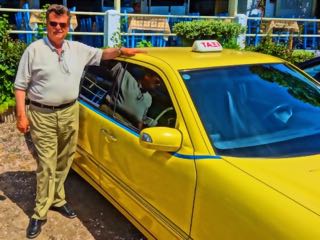
When we finally reach Diakofto again, we head straight for the sea. George is reluctant to go swimming and I don't know if it is because he feels embarrassed about being seen in his bathing suit (he has put on weight since he got famous) or because he does not want me to get sand all over his new Mercedes. I drop a couple hints about the perfect ending to a wonderful trip to Kalavrita being a refreshing swim and perhaps a snack and a drink at the beautiful little fish taverna on the beach. But I don't push it because after all it is George's 'day-off' and I am not really a paying customer. But if you do this trip with George try to leave enough time for a swim and a drink. |
|
We got back on the road to Corinth, with the sea on our left and the mountains on our right and in a couple hours
we were back in Athens. As we passed the straits of Salamina George pointed
to a ship anchored a half mile off shore. "Do you see that ship Matthew?
This is the ship my wife Lula and I took to Australia when we emigrated
there thirty years ago. When we drove by here last week Lula saw it and
started to cry."
I thought about George working in some factory in Australia, or cooking at his restaurant in New York, or driving his Good Humor ice-cream truck through the Bronx in the hot summer. Now here we were in his beautiful new air-conditioned E-270 Mercedes having just seen the beautiful mountains, streams, waterfalls, caves and history of Kalavrita, a trip George will probably take many times as he introduces travelers to the area and maybe even changes a few lives. |
| George... I don't want you to take this in the wrong way. But your talent was wasted in Australia. You belong here,
doing what you are doing, showing people things they won't see on the big
tours. And when you finally retire the Greek Government should thank you
and build a big statue of you standing in front of your taxi in Syntagma
sguare.
This could have been a fruitless summer but instead my eyes were opened to one of the most beautiful places in Greece, with a most tragic history.
|
Practical Information
|
|
For day-trips to Kalavrita or overnights exploring the Peloponnesos and Greek mainland contact George the Famous Taxi Driver who will take care of all the details including hotels, where to eat and putting together a sensible itinerary. There are frequent trains from Patras and Athens to Diakofto. The trip from Athens takes about 3 hours. The train leaves Diakopto at 09:05 - Daily, 11:30 - Daily, 12:49 - Weekends, 14:05 - Daily, 15:30 - Weekends. It leaves Kalavrita at 10:17 -Daily, 12:43 - Daily, 14:03 - Weekends, 15:28 - Daily, 17:23 - Weekends. The price is 9.50 euros each way. If you are planning to rent a car and drive from Athens to Kalavrita or around the Peloponessos check out Swift Rent-a-Car . They will pick you up at your hotel and drive you to the National road and let you by-pass the notorious Athens traffic. See their website For more on the Peloponessos see Matt's Peloponnesos Guide |
|
Where to Eat in Kalavrita To Spiti tis Marios is a chef owned restaurant, gourmet style but traditional dishes like something you would find in Athens or one of the luxury hotels except it is not pretentious, and many people who eat here claim it is the best restaurant in Greece. Athenians actually drive here to eat. But chef-owner George Manikas is known to most of the chefs and eaters of Athens so this is not a surprise. If you want something a little different from your typical Kalavrita psistaria-taverna then this is where you should begin. It is located on the road to Diakofto a few kilometers outside of Kalavrita. If you want to eat at a restaurant that everyone (especially the Greeks) loves then come here. Save room for dessert. If you want to eat in town with everyone else then Varvitsiotis Taverna at Paleon Patron Germanou 28 in Kalavrita is a very good family run meat taverna with decent prices and good service though it can get crowded during the day and night in tourist season. Simple food, as Greek food should be. If you have eaten in a psistaria then you know what you like so order that. But if you haven't go for the beefteki, paidaikia (lambchops), loukaniko kapnisto (smoked sausage), or anything on the grill. Places like this I often go for the pikilia kreaton which basically means mixed grill so you can try a little of everything and come back next time and order what you liked the best. But if they have kokoretsi, kondosouvli or roast pig on the spit I don't see how you can resist. This was one of the first restaurants to honor the no-smoking laws. Oinomagerevo at Paleon Patron Germanou 15, is another family run restaurant serving home-style cooking with meats and vegetables coming from the family farm. The Avli Taverna is right across from the train station and is run by Grigoris who handles the tables and his wife and mother-in-law are in the kitchen. They have very good red wine and the kokoras kokinisto (rooster in red sauce) and the manindaropita (mushroom pie) are popular dishes. Spitiko is also recommended for the same reason as the others: Good simple home style cooking, grilled meats, friendly atmosphere... you get the idea. There are loads of other places to eat, most serving grilled meats and oven roasted meat which is what they eat around here. You can literally just follow your nose and find somewhere good. |
Hotels in Kalavrita |
|
Here are a few hotels in and around Kalavrita. You can click on the name to see more photos, get more information, see the hotel location and to book the hotel. You can find more by using Matt's Kalavrita Hotel Search and if you want to stay on the sea go to Matt's Diakofto Hotel Search |
|
Situated in the entrance of Kalavryta, a 3-minute walk from the town’s centre and the railway station, Archontiko Zafeiropoulou offers elegant accommodation with mountain views. It has a snack bar with a stylish lounge area that opens out to a stone-paved terrace. Zafeiropoulou rooms and suites are warmly decorated featuring oak floors and leather beds. They are equipped with a mini fridge, flat-screen TV and DVD player. Some units also include a balcony and fireplace, while the luxurious bathrooms offer free toiletries. |
|
Azanias Chalet enjoys a beautiful location on the slopes of Helmos, overlooking Kalavrita. It offers autonomous apartments and suites with seating room with fireplace and views over the plain of Kalavrita and the slopes of Helmos. Crafted with wood and stone, the chalet Azanias consists of spacious 2-storey apartments and suites, all with traditional decoration, comfortable sofas and fully equipped kitchens. |
|
Located just 350 feet from the central Kalavrita square, next to the historic cog railway station, Guesthouse Chrysa offers balconies with views to Chelmos Mountain and to the scenic town. The modern, en suite rooms of Chrysa Guesthouse are all equipped with TV, DVD player and fridge while some have a fireplace. Guests can enjoy a rich traditional breakfast including homemade cakes, jams, honey, eggs, omelettes and other local products in the breakfast room of the guesthouse during the winter season. |
|
Located in Kalavryta, this guest house is next to the local street market and just 9.3 miles from skiing activities in Kalavrita. Free Wi-Fi is available. The suites and studios at the Enastron have a spacious balcony with tables and chairs, a kitchen or kitchenette and a seating area with a flat-screen TV. Some units also have a fireplace and panoramic views of the Helmos Mountain. The Enastron also has a bar with a fireplace where guests can enjoy hot and cold drinks. The hotel also offers room service. Traditional products are provided in the rooms for guests to prepare breakfast. |
|
Aphrodite's Inn offers a lounge with fireplace, rich traditional breakfast and rooms with private balcony and heating. It is 6.8 miles from Helmos Ski Centre and 1.6 miles from Kalavrita centre. Surrounded by fir and pine forest, it features rooms with TV and DVD player, fridge and a panoramic view to the town of Kalavryta. Most rooms also include a fireplace. Breakfast includes selected local products and fresh items carefully prepared by the owners. Bicycles are provided to guests wishing to explore the area. Aphrodite's Inn features a private area with horses and ponnies. |
|
Enjoying the dramatic background setting of Vouraikos Ravine and Helmos Mountain, Montage Suites Hotel offers a tranquil sanctuary, featuring rooms
inspired by famous films. |
|
This small hotel is surrounded by luscious greenery, high above the Helmou Valley. The Filoxenia Hotel Kalavrita has 26 recently renovated rooms. We have combined traditional hospitality with a modern service-orientated environment to provide a comfortable and pleasant stay. In the winter you can relax in the lounge by the log fire while in the summer you can sit on your own private balcony and admire the mountain view. In this mountain setting you can enjoy many adventurous outdoor activities, such as orienteering, archery and rafting on the Ladona River. For something more relaxed, we recommend a tour of the caves where you can discover the stalactites and stalagmites and beside the small lakes that shape the majestic surroundings. Wireless internet is available in the entire hotel. |
|
Daphne's Club Hotel Apartments These charming apartments are situated next to Sykia Beach and the unique Pefkias pine forest in Xylokastro. Daphne’s provides quality facilities for the whole family, including free internet access. Each of the apartments is fully equipped with modern amenities, including air-conditioning and kitchenettes. Children have countless options for entertainment, including an outdoor playground and an excellent indoor playgroup. Adults are also well catered for and can even join in with the hotel’s workshops, including yoga and belly dancing. The doors to the lounge open onto the beautiful hotel gardens in the summertime. Guests can admire the surrounding scenery of sea and mountains from the delightful rooftop garden. The pine forest and the beach are just 30 metres from the hotel, creating an exciting place for the whole family to explore. Wireless internet is available in the entire hotel and is free of charge. |
|
You can find hotels, villas, apartments and holiday homes by using Matt's Kalavrita Hotel Search and by booking this way you help to support Matt Barrett's Greece Travel Guides. You can also find hotels at Matt's Hotels of Greece Peloponnesos Page |
|
You can also find more hotels by request from Dolphin Hellas Travel and Fantasy Travel |


 In a small bookstore I find a copy of "The Drama of Kalavrita" by Dimitris
Kaldiris which tells the story of the massacre when the Nazis in retaliation
for the execution of some German soldiers by the Greek resistance, executed
over 1200 boys and men from the ages of 13 to 70 and then burned the entire
village to the ground on December 13th 1943. The book is an eyewitness
account of the murders and contains interviews with some of the survivors.
Reading this book is a sad experience but one that is essential for understanding
the area. The book is a memorial to those who died that day and a tribute
to those who survived the harsh winter that followed, with no food, homes
or heat. You should be able to find it in one of the shops in Kalavrita but if not you may be able to order it from
In a small bookstore I find a copy of "The Drama of Kalavrita" by Dimitris
Kaldiris which tells the story of the massacre when the Nazis in retaliation
for the execution of some German soldiers by the Greek resistance, executed
over 1200 boys and men from the ages of 13 to 70 and then burned the entire
village to the ground on December 13th 1943. The book is an eyewitness
account of the murders and contains interviews with some of the survivors.
Reading this book is a sad experience but one that is essential for understanding
the area. The book is a memorial to those who died that day and a tribute
to those who survived the harsh winter that followed, with no food, homes
or heat. You should be able to find it in one of the shops in Kalavrita but if not you may be able to order it from 


 The women and children they locked in the schoolhouse where they watched their village burn around them. Were
it not for a German soldier who disobeyed orders and unlocked the door
allowing them to escape perhaps they too would have died. The soldier never
returned home. The women looked for the men. Some said they had been put
in box cars and taken away by the tooth train. Some said they heard they
were locked up somewhere. It was not until late afternoon that they found
them in Kapis field. By then the Germans had escaped.
The women and children they locked in the schoolhouse where they watched their village burn around them. Were
it not for a German soldier who disobeyed orders and unlocked the door
allowing them to escape perhaps they too would have died. The soldier never
returned home. The women looked for the men. Some said they had been put
in box cars and taken away by the tooth train. Some said they heard they
were locked up somewhere. It was not until late afternoon that they found
them in Kapis field. By then the Germans had escaped. To stand and look at the monument and think of the tragedy is one thing. But to read the accounts of the survivors
opens up a door of sadness that gives life to the scene and the surroundings
and I encourage anyone visiting this site to read this book first. The
pain the women of Kalavrita must have felt when they came to the field
and found the bodies of husbands, friends, neighbors, fathers and
children is unimaginable. And what about the suffering they must have gone
through in that first terrible winter after the massacre, their homes in
ruins and all food, animals, valuables and oil taken away by the Germans
on the little train that has chugged up and down the mountain for 100 years.
To stand and look at the monument and think of the tragedy is one thing. But to read the accounts of the survivors
opens up a door of sadness that gives life to the scene and the surroundings
and I encourage anyone visiting this site to read this book first. The
pain the women of Kalavrita must have felt when they came to the field
and found the bodies of husbands, friends, neighbors, fathers and
children is unimaginable. And what about the suffering they must have gone
through in that first terrible winter after the massacre, their homes in
ruins and all food, animals, valuables and oil taken away by the Germans
on the little train that has chugged up and down the mountain for 100 years.






Help Support Matt's Greece Guides
Do you enjoy using my site? Have you found it entertaining as well as useful? If so please show your appreciation by booking hotels through the travel agencies and the links found on my Hotels of Greece site. The small commission I make on the bookings enable me to keep working and in most cases you won't find them any cheaper by searching elsewhere. You can find
hotels in Greece by location, price, whether or not it has a swimming pool, and see photos and reviews by using this link to booking.com which also contributes to my website when you book. If you are appreciative of all the free information you get on my websites you can also send
a donation through Paypal or Venmo
Join Matt Barrett's Greece Travel Guides Group on Facebook for comments, photos and other fun stuff. If you enjoy this website please share it with your friends on Facebook and other social media.
