Matt's Greece Travel Blog
Pakistanis in Greece:
|
|
Later on the ferry back to Athens we spotted each other and we talked, he in two barely familiar languages and me in one. His name is Ali and has been in Greece for several years living in an apartment with some other Pakistanis somewhere near Omonia Square. He had come overland through Iran and Turkey. The last part of his trip, by fishing boat from Turkey to Greece had cost him 8000 euros. He had working papers but no steady work. In Athens he had done what many Pakistanis and other immigrants do, wash windshields of cars at stop lights, sell bottles of water, flowers, tissues or anything sellable. They make around 30 euros a day doing this which is enough to eat and pay the rent but standing on a busy street corner in Athens is nothing you would want to make a career of. His job at home and primary experience was working on farms and his expertise was horses. But there are no horses in Athens and few jobs in the countryside these days. Its a pretty bleak existence but better than where he was coming from, he told me. He didn't seem especially eager to move on to Northern Europe, Canada or the USA. I asked him if he wanted to move to America. "Are there horses there?" he asked. "If there are then yes." But Greece was OK with him. Life was hard but if you were industrious you could find work of some sort. He told me he was going a couple times a week to Markopoulos where there are stables and horses and maybe something good would happen for him sooner or later if he was persistent. He asked me what my job was and I told him I was a travel writer which is what I say if I want to end that line of questioning. Its a simple answer and everyone has a good idea of what that means. But when I said it I felt like a phony. I don't think Paul Thereoux would call me a travel writer. I don't think Paul Hellander or David Willet of Lonely Planet and Rick Steves would call me a travel writer. I write. I travel a little, mostly in Greece. But a travel writer is a professional and whether he is in Greece, New Zealand or Tierra del Fuego, he has an ability to look around and see what is useful and interesting and is able to explain it in words. I am just a guy lucky enough to be half Greek and half American at a time when the internet blossomed and travelers were still coming to Greece. I know Greece and I have an ability to describe it because it is so familiar just as you could probably describe your home town in a colorful and amusing way. But had Ali and I met a hundred years ago I would be the penniless traveler and he would be a horse expert in a land full of horses. I was thinking about this as we talked but mostly my mind was on my car which was packed to the gills with stuff from Kea that we were bringing back to Athens. Our winter clothes, a giant can of olive oil from Lesvos, some canned food and herbs, my acoustic guitar, Amarandi's bass and amplifier, and bags of stuff that would probably just be put into storage somewhere else, maybe our apartment in Athens or the basement of the Hotel Attalos. I was thinking about how difficult it would be to rearrange all the junk in our car so we could make space and offer Ali a ride into the city. Actually I was almost ashamed to have a car and as we sailed into Lavrion and people got up to make their way to the back of the ship to get off he shook my hand and said goodbye and I was kind of relieved that he would not see me go to the garage and get into my car crammed full of crap, like a typical American. I saw him waiting for the bus to Athens and asked Andrea if we should pull off and try to make space for him but she torpedoed the idea. Anyway he would be in a big comfortable seat on a nice air-conditioned bus that would take him a block from his neighborhood, rather than being scrunched up in the back seat with a bag of clothes on his lap and then have to get out in the rain to take a bus from Psychiko. In other words it was not like he really needed a ride. It would have been more of a nice gesture. Which brings me to the point of this week's sermon. We are all blessed. If you have the money to travel you are blessed. It means you are paid well enough for what you do, to be able to spend a couple weeks in Greece. What you do has value in the society you live in. Call it luck, a blessing, good fortune, God's Will or whatever you want. But it is something to be thankful for because you could have just as easily been born an Ali, an expert with horses in a land of automobiles. And Athens is full of guys like Ali. From small villages and cities in Pakistan, Bangladesh, Africa and other places where the future is hopeless they come to Greece where they can at the very least sell bootleg CDs and DVDs or copies of designer handbags on the streets of Athens or possibly become an intergal part of a growing ethnic community, maybe open a shop or work for a fellow countryman who has "made it" in Greece. Some have escaped war, torture, famine or prison for their beliefs and for those people Athens is a step closer to paradise. For those of us who sit in the restaurants and cafes, complaining about the price of a coffee, they are a nuisance, an endless stream of street merchants, that ask at every table, thousands of tables a day, to make enough to eat and have a place to sleep. But these are not beggars or people asking for a handout. They are working, doing the only job they can get. Maybe at home they were farmers, or factory workers, or really any profession, it doesn't matter. In Greece they start on the streets. I met one guy, his name was Chico and he sold CDs in Athens and on the ferries and the islands and sent the money home to his family in Kenya. "What work did you do in Kenya?" I asked him. "I had a printing press. It went out of business and there was no work anywhere so I came to Greece." One day an accordion player serenaded our table and one of our Athenian friends said something insulting about his playing. "Excuse me sir", said the musician in perfect English. "I am a classically trained piano player and I was playing with the Orchestra in Romania before it went bankrupt." Maybe one day people won't visit my website. The google ads which are my bread and butter will dry up and then what talent do I have to fall back on? Will I pick up my guitar and walk around the Plaka going from table to table singing "The Needle and the Damage Done"? Maybe sell postcards made from my photos, or join the Africans selling my old CDs. The late great Phil Ochs wrote a song called There But for Fortune. The lyrics are: Show me a prison, show me a jail These people on the streets of Athens who are now so much of the landscape are human beings who got a raw deal. They are the bottom rung of globalization. A Mexican farmer who crosses the border into the US can work and own a car in a couple months, a house in a few years and their kids can grow up to be businessmen, teachers, congressmen, senators and even one day President of the United States. The immigrants in Greece won't have such opportunities. With hard work and a little luck they may get a job in a factory or a shop. But the most likely scenario is selling on the streets for the indefinite future. If you are sitting in a cafe paying 4 euros for a cappuccino then you can afford to buy some piece of junk for 1 euro and if you don't find it useful, give it to someone as a gift, or leave it as a tip for the waiter. If you have fallen for the argument that buying bootleg CDs supports organized crime I will let you in on a little secret. The music industry is organized crime. You are just choosing which criminals to support and at least with the bootleg CDs the poor African guy is getting some of the money. Let me prove my point. Several years ago some friends of mine invented a technology that would make ripping off copyright material on CD or DVD impossible. Without going into detail, their technology would enable someone to copy music or film or computer software but after the first use it would begin to deteriorate. So they shopped it to all the media companies. They met with the top people and every company was interested. But without exception they all wanted to get enough information so they could give it to their own technicians and they could 'invent' the technology for themselves. In other words they did not want to buy the technology. They wanted to steal it. So save your compassion for the poor people on the streets. Bootlegging could have been a thing of the past but because the media companies have the same criminal mentality as those who steal the music, the cat is out of the bag and thousands of Africans and Asians are surviving on the streets of Athens and other countries, selling CDs and DVDs. They are not criminals. They are not bad people. They are the bottom rung of the working class, trying to escape poverty the only way they can. And there but for fortune go you or I. |
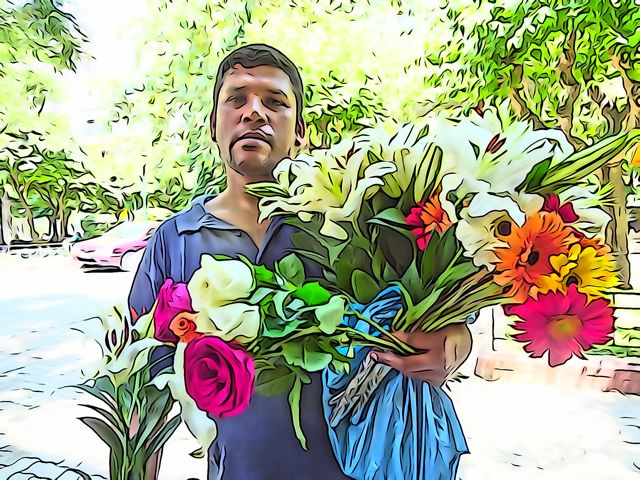 I met a young guy from Pakistan yesterday in Yannis Restaurant in the Piazza in Kea. Andrea and I had come back from the bank and in order to test my bank card on the ATM machine I had made a withdrawal that I really did not need to make since I already had a pocket full of spending money and now I had more. I thought
the
Pakistani guy was one of the Indians who live on Kea and work at various jobs, mostly at the gas stations. I asked him if he knew Rana, the one Indian guy whose name I knew, though I say hi to all of them, seeing them as kindred spirits in a way; Fellow strangers in a strange land. I realized he was not one of the Indians and we talked for a few minutes in broken English and even more broken Greek and I came to understand he was not one of the local easterners but was living in Athens and had come looking
for work. When I got up to pay I told Yannis that I was paying for the Pakistani guy too. I was not being magnanimous or anything. It just seemed so American to be there with a pocket full of euros I did not particularly need and this guy had barely enough money for a plate of food and the ferry. Plus its hard not to be in a giving mood in Yannis restaurant since he is always treating people to a carafe of wine, or reaching into the cooler to put a beer on the table of a friend or steady customer. Even a conversation
with an old man at the next table can lead to the discovery that your wine has been paid for when you go to pay the bill and the old fellow is long gone. So treating someone is normal.
I met a young guy from Pakistan yesterday in Yannis Restaurant in the Piazza in Kea. Andrea and I had come back from the bank and in order to test my bank card on the ATM machine I had made a withdrawal that I really did not need to make since I already had a pocket full of spending money and now I had more. I thought
the
Pakistani guy was one of the Indians who live on Kea and work at various jobs, mostly at the gas stations. I asked him if he knew Rana, the one Indian guy whose name I knew, though I say hi to all of them, seeing them as kindred spirits in a way; Fellow strangers in a strange land. I realized he was not one of the Indians and we talked for a few minutes in broken English and even more broken Greek and I came to understand he was not one of the local easterners but was living in Athens and had come looking
for work. When I got up to pay I told Yannis that I was paying for the Pakistani guy too. I was not being magnanimous or anything. It just seemed so American to be there with a pocket full of euros I did not particularly need and this guy had barely enough money for a plate of food and the ferry. Plus its hard not to be in a giving mood in Yannis restaurant since he is always treating people to a carafe of wine, or reaching into the cooler to put a beer on the table of a friend or steady customer. Even a conversation
with an old man at the next table can lead to the discovery that your wine has been paid for when you go to pay the bill and the old fellow is long gone. So treating someone is normal. E-mail me with questions and comments. Join Matt Barrett's Greece Travel Guides Group on Facebook for comments, photos and other fun stuff. If you enjoy this website please share it with your friends on Facebook, Tripadvisor, and other social media. If you are appreciative of all the free information you get on my websites you can send a donation through Paypal

|
|
|